
In 2020, WhiteBridge published a guide to sales prospecting. Last month I sat down to bring it up to date, and deleted 5 of its statistics. Not because they were wrong. Because I couldn't prove they were right.
What was in there?
The guide carried the sort of figures that circulate freely in our industry.
Buyers are 57% of the way through the buying process before they contact a supplier. 50% of sales time is wasted on unproductive prospecting. 64% of teams using inbound selling reach quota, against 49% of those using outbound only. Experienced salespeople can expect to spend 7.5 hours of cold calling to get one qualified appointment, according to a Baylor University study.
They had sat in that document for about 6 years. They looked authoritative. I had never checked a single one of them.
What happened when I looked?
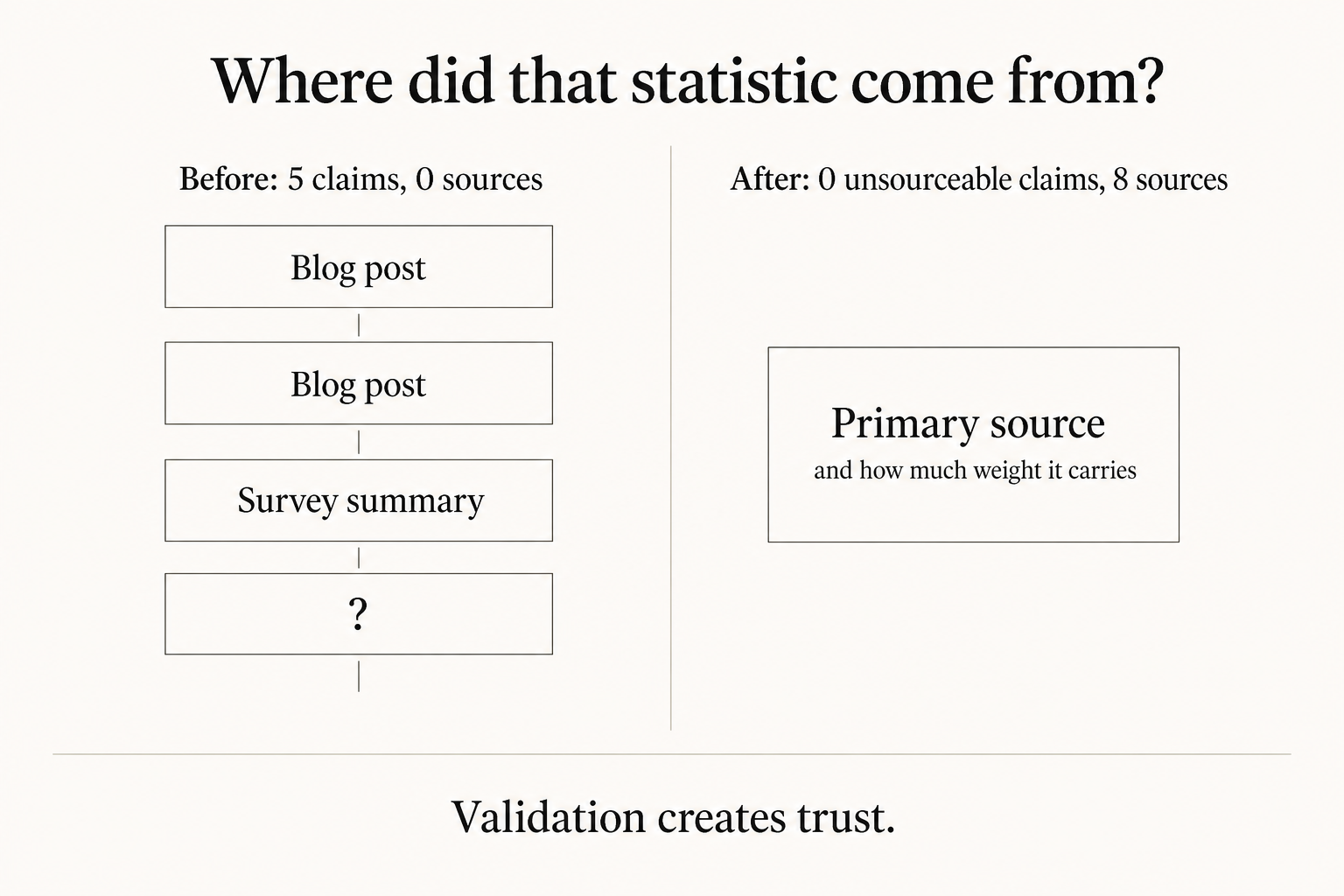
Every trail ended in the same place: another article citing another article.
The 57% figure is repeated across hundreds of pages. Where the underlying research exists at all, it is around a decade old, and the specific number is rarely attributed to anything you can open and read.
The Baylor attribution was the one that bothered me most. It appears on dozens of sites, always phrased almost identically, and I could not find the publication behind it. That does not prove no such study exists. It does mean I had been repeating a claim I could not stand behind if a client asked me where it came from.
So all 5 came out.
This is not really a story about carelessness
It would be comfortable to file this under my own sloppiness, and there is some of that. The more useful reading is, however, structural.
Our industry recycles its numbers. A vendor publishes a survey. A blog summarises the survey. A second blog cites the first. A guide cites the second. By the fourth hop the figure has lost its date, its sample, its method and its caveats, and gained the authority that comes from being everywhere.
Nobody in that chain is lying or trying to mislead us. The result is still unreliable.
And sellers are unusually exposed to it, because we are in the business of persuasion. A number makes an argument feel settled. That is exactly why it deserves more scrutiny than the sentence around it, whereas it usually gets less.
What I did instead
The new edition takes its figures from primary sources only. Being based in Norway, I write about the Norwegian regulator rather than offering a summary of the regulator. In addition, I mention Google's own sender documentation rather than an article about it, a research firm's own newsroom rather than someone's write-up.
Then I added an appendix that lists every source, with a note on how much weight each one will carry.
One entry says the figures are taken from a press release about a report that sits behind a paywall, which I have not read, and that this citation is therefore weaker than the others and should be treated that way. Another notes that a vendor's research comes from a vendor who sells the thing the research recommends, so the direction is informative and the precision is marketing.
That appendix was uncomfortable to write. It is also the part of the guide I am most confident about.
The 10-minute test
If you want to run this on your own material, it takes very little time.
Take one piece of collateral you use with prospects. Find the most impressive statistic in it. Give yourself 10 minutes to locate the original study: not the article quoting it, the study. Open it. Check the date, the sample and the question that was actually asked.
If you cannot get there in 10 minutes, delete the figure. Your argument will survive. Most arguments propped up by an unsourceable statistic were fine without it. Instead, it is the ones that were not that should worry you.
Why this matters more than it used to
Many buyers now start in an answer engine (not a search engine) and, by Forrester's account of its own 2026 research, often distrust what it tells them, which sends them back to their networks to check. Verification has become the scarce commodity.
In that environment, a claim you can trace is worth more than a claim that merely sounds impressive. Being the supplier whose numbers hold up is a slower position to build and a harder one to dislodge.
Validation creates trust. Sales is all about trust.
If you want the guide
The rewritten edition is published, and the sources appendix is the last thing in it. Anyone can read the working. You can download it here.
And if you run the 10-minute test on your own collateral and find something uncomfortable, I would genuinely like to hear about it. I have been there recently, and it is a better conversation than most of the ones we have on this platform. A short conversation costs you nothing but the time. Half an hour, no charge.
Related

The pitch I turned down...
In "customer acquisition", "prospecting effectiveness", "competitive advantage", "sales effectiveness", "adding value", "pipeline management", "opportunity management"

Sharper reps, later in the conversation
In "customer acquisition", "prospecting", "sales effectiveness"

The 95% you are not selling to
In "customer acquisition", "competitive advantage", "sales effectiveness", "building relationships", "pipeline management", "opportunity management"